Thursday, November 17, 2011

2011 Christmas Pageant


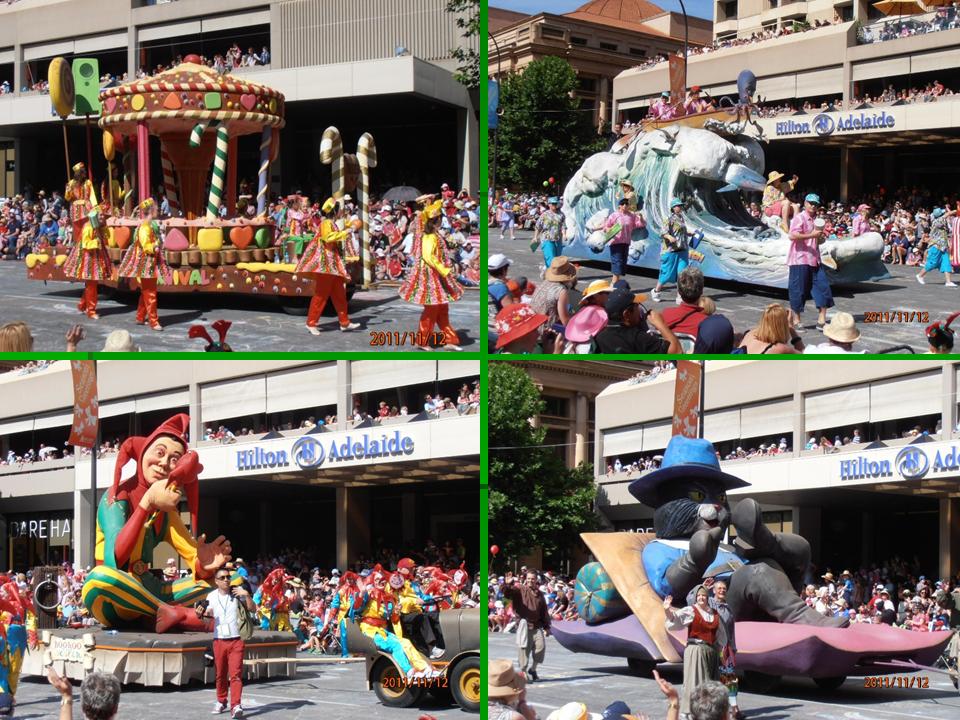
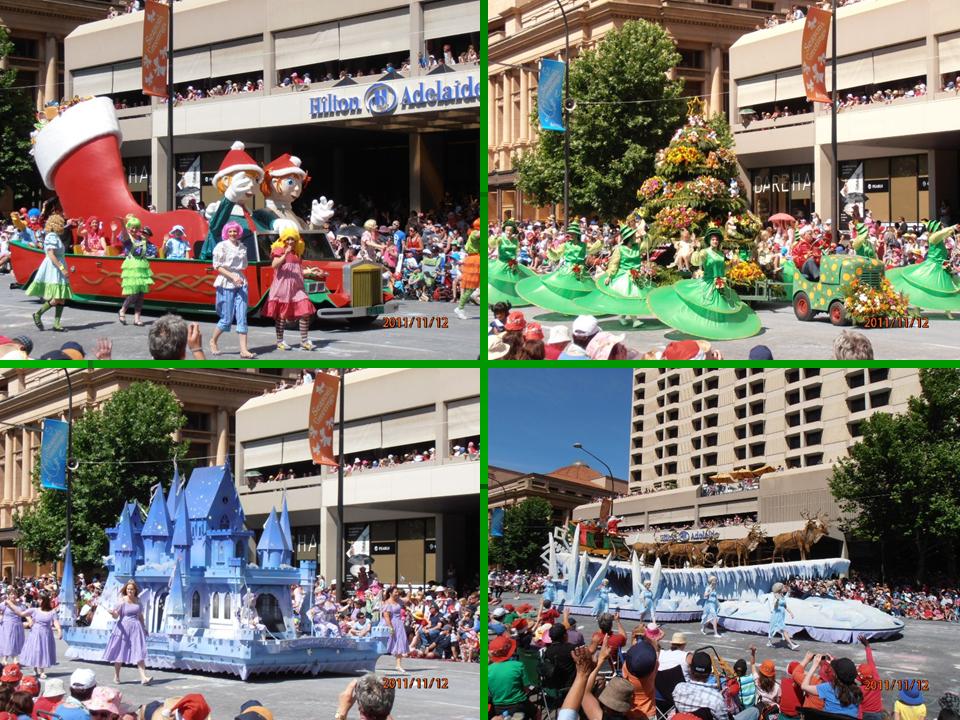
The Adelaide Christmas Pageant is an annual event held 6 weeks before the big day. This is one of the biggest events in the city and every year around 300.000 people  gather and watch the more than 60 floats parade through the city centre for 3.35km. The parade starts  at South Terrace, continues along King William Street and concludes on North Terrace where Father Christmas arrives at the Magic Cave in the David Jones Building. 


It is one of the traditions in Adelaide that the Christmas Pageant marks the beginning of Christmas celebrations, along with The Brewery Christmas Lights that winds along the Torrens River the start of Port Road,  the Lights of Lobethal and Carols by Candlelight.  Some families will start decorated their homes with lights both inside and out for all to see.


As this is my first pageant, I was very excited and took a lot of pictures. But next year maybe I'll just watch it on the television, even though the feeling won't be the same. Here are some of the pictures (believe me, there are many more...lol). Please enjoy......






Tuesday, October 25, 2011

The Port Festival 2011


The Port Festival is an arts and cultural voyage that has something for everyone . This years festival was held on the weekend of the 9th and10th of October. The biennial festival celebrates Port Adelaide's distinctive character - its people, places, culture, heritage and natural landscape. Only 20 minutes from the city of Adelaide, the Festival attracts the Port's locals as well as audiences across Adelaide and beyond, with more than 60 local organisations taking part. It was is an open-access and multi-faceted celebration offering a smorgasbord of activities, including music, art, food, workshops, guided walks, river cruises, and much more.


We started our tour from the Port Adelaide market which is popular for those who are hunting collectables, books and bric-a-brac.The market is located near the iconic lighthouse with the finest colonial and Victorian buildings all around. 


During the Port Festival weekend, the SA Maritime, Railway and Aviation museums were all open for free. Usually the ticket price is around $10-$12 for adults, so this was a very good chance to see what they have there. 


After spending the whole day at Port Adelaide, David took us to the North Haven Marina for a cup of coffee.  

Sunday, October 9, 2011

McLaren Vale Wineries Tour

McLaren Vale, one of Australia's oldest wine making regions, located approximately 35km south of Adelaide. The region consistently produces fine wines from a number of varieties, most importantly Shiraz, Cabernet Sauvignon and Chardonnay. On this long weekend, with a few friends we drove along the main street and visited some of the cellar doors.


On the way, we stopped by at the Almond Train. They have a selection of more than 25 flavoured almonds and premium raw Willunga almonds. Free tasting's are conducted daily of almonds and varietal olive oils, olives, dukah, local jams, chutneys and honey.


The first winery we visited was Primo Estate, the home of JOSEPH wine and olive oil. In the 1980's Primo Estate became one of the first extra virgin olive oil producers in Australia. Their JOSEPH Cold Pressed and First Run olive oils have been acclaimed by chefs and gourmets around the world. In 2006 Primo Estate opened a stunning new McLaren Vale cellar door and tasting room, combining ultra modern design with Italian style, just like their wines and olive oils.


The next stop was Hugh Hamilton Wines. Hugh is the fifth generation of the family that planted the first vineyards at Glenelg in 1837, less than one year after European settlement in South Australia. As with all families one is a black sheep and Hugh Hamilton is it. You can expect therefore to enjoy the difference.

Battle of Bosworth was established in 2001 by Joch Bosworth and Louise Hemsley-Smith. The wines take their name from the original Battle of Bosworth, fought on Bosworth Field, Leicestershire, England in 1485. Battle of Bosworth make wines with flavour, texture, purity and balance, that best express the unique characteristics of their McLaren Vale foothills site. Joch and Louise also make the Spring Seed Wine Co range of wines, which are also made using organically grown grapes from their vineyards.


Lunch time! Our friends brought Vietnamese rolls and beef for barbecue. That's very nice. 


After lunch, our wine testing continued. The next stop was Fox Creek Wines. The story began when Jim and Helen Watts bought the 32 hectare Fox Creek Vineyard property in 1984. Leader of the pack and the first wine made at Fox Creek was our 1994 Shiraz, which won the Trophy for the best wine at the McLaren Vale Wine Show in 1995. Success has continued and Fox Creek now markets single varietal wines from Shiraz, Cabernet Sauvignon and Merlot and blends of Cabernet Sauvignon and Merlot (Duet), Shiraz and Cabernet Franc (JSM), Shiraz and Grenache, and a sparkling Shiraz Cabernet Franc (Vixen). The white wines produced are a Chardonnay, a Sauvignon Blanc and a Verdelho.

Tucked away in the eastern foothills of McLaren Vale, Pertaringa is a progressive family-owned winery and cellar door focusing on crafting superb wines from sustainably run vineyards. The name Pertaringa means ‘belonging to the hills’ and originates from the local Kaurna indigenous language. Situated across the road from Noon Winery in this beautiful part of McLaren Vale, Pertaringa is off the beaten track and definitely worth discovering!

David Paxton believes that those who apply the art and science of viticulture are just as important as the winemaker. For three decades the Paxtons have nurtured their prized McLaren Vale vineyards, some of which are over a hundred years old. It's this level of care and passion that has produced extraordinary fruit and wines.


That was the last wineries we were visited for this trip. Although we were a bit dizzy afterwards but we had so much fun and had planned for another go out together again soon.   

Friday, September 30, 2011

Class Excursion

At the end of this term, our class had a sfew class excursions. One of the excursion was walking down North Terrace to see all the statues of famous people. We started our tour at the corner of King William Street and walked up to the Adelaide University.

Thank God the weather was very good and that put everybody in a good mood, as these pictures show. 


Our teacher was our tour guide. She explained about every building and every statue that we saw. The first stop was at Parliament House. This grand building is built of grey marble and is located at the corner of King William Street and North Terrace.


Across from Parliament House, we saw the first statue. It is the South African War Memorial, also known as Boer War Memorial. This is a memorial to the soldiers who fell during the Boer War between 1899 and1902. Standing in front of Adelaide's Government House, it is considered one of the city’s most important statues.


The next statue was of Dame Roma Mitchell, the first female Supreme Court Judge of the Commonwealth. In 1991, she also became the first woman appointed as the Governor of South Australia. 


Still in front of Government House is Venus, the Roman goddess of love and beauty. The Venus statue which is made from marble was the first statue in the Adelaide of city.   


A few meters from Venus, there is a section named Prince Henry Garden, where we found some portrait busts. 


Lord Florey, who was jointly awarded the Nobel prize in 1945 for his great contribution to the development of penicillin as a systemic antibacterial agent.
Sir Mellis Napier, a Lieutenant-Governor of South Australia from 1942-1973. The portrait erected in 1970 is a tribute to his great public service.
Sir Mark Oliphant, one of Australia's great scientists, a man with a brilliant mind. Yet many remember him for participating in something he would prefer to forget, the creation of the atom bomb.


Mary Lee, a secretary and leader of Woman's Suffrage League of South Australia.  She was very interested in education and further education for girls, she fought for better conditions for women and women's right to vote and stand for Parliament. 


The next one was of Matthew Flinders, navigator, hydrographer and scientist. Flinders was to first man to circumnavigate Australia and who suggested the name of Australia. He proved that Australia was not a series of islands, but one island. His charts were so accurate, that they were used for many years after his death.


The National War Memorial is a monument for commemorating those who served in the First World War. On bronzes line the walls of an inner shrine were listed the names of all South Australians who died during the Great War. Memorial services are held at the site throughout the year, with major services on both Anzac Day (25 April) and Remembrance Day (11 November). In front of the monument we took our class picture.


Unveiled on 15 July 1920, the King Edward VII Memorial is positioned on the north side of North Terrace, in front of the Institute Building and State Library of South Australia owned by the Adelaide City Council. He was the King of United Kingdom and the Commonwealth from 1901 to 1910. 


In front of the State Library, stands the statue of Robert Burns, a national poet of Scotland. The marble statue was presented by Caledonian Society in 1894. 2011 marks the 252nd anniversary of the Robeth Burn's birth.


In front of the University of Adelaide there are the monuments of Sir Walter Watson Hughes, one of the founders of the University and it's first donor and Sir Samuel James Way, an outstanding citizen who proved was a great judge and gave outstanding service to South Australia during almost 40 years as Chief Justice. He became a Lieutenant-Governor of South Australia in January 1891.


Last but not least was the statue of Sir Douglas Mawson, Australia's most famous Antarctic explorer. His story reveals a man who gave his energy and almost his life to exploring and studying the coldest place on earth.

From here went back to Tafe-Rundle Mall. On the way back we  looked for a cafĂ© to sit and had a cup of coffee. Everybody was happy and had a wonderful day out. 


Sunday, September 18, 2011

Cultural journey at Moon Lantern Festival 2011


Elder Park was alive again with the sights, sounds and tastes of Asia. A host of multi cultural Asian performers were on the centre stage, various food stalls sold a range of speciality dishes from their country of origin and thousands of people gathered together to celebrate The Moon Lantern Festival.


The performances on the big stage started at 3.30pm. Various performers from Indonesia, Japan, Korea, Vietnam, India, China and some other Asian countries took turns at amazing the audience. There was also a special performance from the Shangdong Performing Art Troupe. Shangdong Province in China is the home of Confucius and has been Adelaide's sister city for 25 years.


This year, we enjoyed the festival with my father in law and my classmate, Vinh and her husband. We visited each tent taking in all the cultural demonstrations and checked out all the food stalls before we decided what we would have for dinner. So many choices always makes it hard to choose.


Even though the weather was not very pleasant, a lot of people still came to enjoy the atmosphere. I felt so sorry for those who had to wear their costumes without wearing a jacket.


As the sun set, school children, their parents, teachers and community groups paraded with traditional
and contemporary hand‐made lanterns that lit up Elder Park celebrating the beauty of the full moon.


The festival closed with fireworks display.


This year we were honoured with a gift of Moon cakes from our friends at the Dang Pharmacy...thanks Mia!